Part 3
Updated: Jul 12
Conclusion
The official story of a deadly coronavirus defies all principles and knowledge of medicine and epidemiology. A deadly respiratory virus will cause excess mortality of 10% or in a worst case scenario, 20% above normal for a period of about 4 weeks. It means an increase in mortality of 1-2% above the expected for the entire year.
Poland had an excess mortality of 29% for the year 2021. Only 28,500 out of the 80,000 excess deaths for that year, were classified as Covid-related.
Tunisia had an incredible death rate in July 2021, officially because of a Delta variant of coronavirus that was supposed to be mild. Why in July, and why the hot and sunny weather didn’t help?
Coronaviruses, just like influenza viruses, follow seasonal patterns. Infections don’t occur randomly in any given month and they don’t cause more than one period of health crisis in a year. They don’t cause a sustained rise in all-cause mortality over the course of a year either.
The vaccination program causing the excess mortality worldwide is a myth easily debunked. The health crisis in Latin America in 2020, on its own, defies all logic. In Ecuador in the first two weeks of April, 5,000 people or more died “from COVID-19” in its largest city of 3 million inhabitants. The government of Guayas Province, where Guayaquil is located, said 6,700 residents died in the first half of April, compared to 1,000 in a normal year.
The exact same virus caused no harm in Eastern Europe or East Asia. The reading of the Our World in Data charts below is recommended up to September 2020. The excess mortality charts and the chart “Daily new confirmed COVID-19 cases per million people” cover data up to March/April 2021.


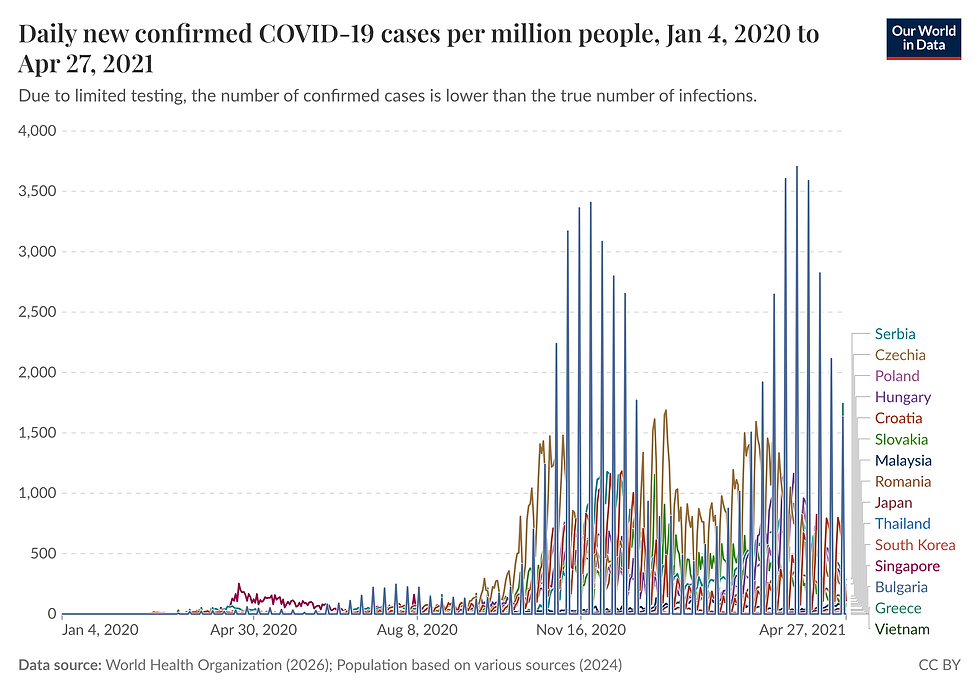
Many indicators suggest that the narrative of a pandemic causing the health crisis since 2020 is unfounded. Excess mortality at levels near or above 20% continued in East Asian countries, like Singapore, Japan, Taiwan and Thailand until the end of 2024, if the charts of Our World in Data are relied upon as a guide. Governments might dispute these findings, citing reasons that include the aging populations, and revise the percentage of excess deaths downward to lower figures. However if charts of many countries are combined, it is hard to deny that a problem exists. There is no doubt that lockdowns or restrictions in the years 2020 and 2021 have nothing to do with the phenomenon of excess deaths, or contributed very little to it.
Technology causing harmful radiation is the only remaining explanation. There are two possibilities: 1.The normal function of technology. 2.Technology being used as a weapon. Regarding the first point, scientific papers and articles have been published already in 2021, relating the health crisis attributed to a pandemic, to the normal operation of the newly installed 5G towers. However there is clear evidence that the health crisis in certain countries was unrelated to 5G. The second possibility about technology being used as a weapon against populations, could have something to do with radiation emitted by telecommunication towers, or directly by satellites, or gadgets like cell phones and computers. Several factors make the gadget hypothesis quite improbable. I am referring to inflammatory diseases affecting very young children, diseases and behavioral changes in animals, and climate change — if it is considered to be caused by radiation and not by increased gas emissions.
What is new in recent years? I present it in chronological order:
1.The low orbit satellites that have been in operation since May 2019. The first 60 Starlink satellites of Elon Musk’s SpaceX, launched on May 23, 2019. In 2022 they were about 2,000 satellites orbiting over the earth and two years later, more than triple that number. They have two key differences compared to the conventional satellites orbiting over the Equator line at almost 36,000 kilometers above the Earth’s surface. The new satellites, known as low orbit satellites, are over the countries they are providing their coverage, at a distance of 550 kilometers above the surface of the Earth.
2.The launch of 5G towers and networks.
3.The health crisis attributed to COVID-19 but in reality it appears to be an increase in mortality from various diseases, including diseases of the respiratory system. The increase in mortality is either short term and appears to be caused by a viral epidemic, or is continuous lasting for months or years.
4.The global vaccination program against COVID-19. The vaccines were produced with a new untested technology. Untested, meaning long-term trials haven’t been conducted. The short term trials by the big pharmaceutical companies also caused controversy. Since the beginning of the COVID-19 pandemic, several countries have experienced an increase in diseases, including respiratory diseases, autoimmune diseases and cancer, or an increase in deaths from all causes. Although statistics are currently scarce, it is well known among physicians based on observation, that these diseases occur more frequently or develop more rapidly. Furthermore, there have been changes in the age groups in which certain diseases are observed. Is it possible that vaccines are contributors to this phenomenon? It will be very difficult to find out if almost the entire adult population in each country took at least one dose of an mRNA or viral vector vaccine. It is unfortunate that when health authorities were immunizing almost the entire adult populations against COVID-19 they were at the same time eliminating the control group in future studies on the cause of changes in the incidence of diseases. The only realistic option for scientists to discover the contribution or vaccines or something else to rise in diseases like respiratory diseases, cancer, neurological diseases and diabetes, is to examine countries or large cities with an excess mortality problem since the end of the pandemic, assuming there’s a significant number of people in the population who have not received any vaccine doses. Concerning Bulgaria and Romania, they have been cited as the example to avoid during the COVID-19 era, highlighting what happens when the rules set by global authorities or prominent individuals are not followed. They topped the European list of deaths attributed to the coronavirus. It is quite interesting how these countries fare since the spring of 2022.


