COVID-19 Pandemic or Radiation Illness?
Updated: Jul 12
Author: Constantinos K. Kapodistrias.
I declare no conflict of interest.
Part 1 - THE STUDY
First published online: May 2026
Methodical notes
I am looking for patterns, unusual weather followed by completely unexpected increase in mortality to extraordinary levels, since the year 2020. More precisely, I am looking at whether a period of extreme temperatures is followed one to two months later by a dramatic rise in excess deaths in a country or a group of neighboring countries. A drought as an early warning for a health crisis is examined as well. Since a clear cause-effect relationship is investigated, I don’t place emphasis on countries that present a blurred picture, meaning, they have a prolonged period of excess deaths or Covid cases with moderate fluctuations. In the same way, countries could experience a prolonged period of drought, like Portugal from October 2021 onward, or Latin American countries from 2020 onward and make it harder to reach a conclusion. Nonetheless I document droughts below in different parts of the world.
Countries with tropical or subtropical climates, from Cuba and regions of South America to South East Asia don’t show a pattern of drought or heatwave preceding a health crisis, but the unique characteristics of their climate should be considered.
Heatwaves and droughts are nothing new, they have always been happening. However, climate change in many countries in recent years has been drawing attention, as well some changes in the health of populations. A virus season could start at an unexpected time, the incidence of diseases has changed, certain diseases are observed in younger age groups compared to years ago, and people who have never been sick in their lives from respiratory diseases like a common cold, suddenly now they do. The number of deaths from all causes in several countries has increased. Before I begin, I stress the fact that the health crisis since 2020 appears to be excess deaths from all causes and not just from a respiratory virus. The evidence I present below is based on statistics from health authorities. I also examine the possible causes of the changes in people’s health worldwide. Unlike previous studies that examine the potential connection of disease and deaths with the normal functioning of new technology, namely the 5G network, I examine as an additional possibility the potential use of new technology as a weapon against mankind.
In the study that follows, I present two sections. The first section contains the weather news, the date of publication and the link to the original source, relating to a country or group of countries. The second section includes the graph of excess mortality for the same geographic locations in the following months, as well as additional notes of mine.
All charts presented in the study are from Our World in Data.
COVID-19 PANDEMIC OR RADIATION ILLNESS?
Bulgaria, Romania, North Macedonia, August 2021
This article reported that temperatures across the Balkan Peninsula — including nations like Greece, Albania, North Macedonia, Romania, and Bulgaria — were expected to rise roughly 15°C above average. This marked an unusually intense heatwave for early August. Southern Italy and particularly western regions of Turkey were also likely to face very hot days during this time, according to the article. Extreme temperatures were recorded in both countries starting from the end of July according to several articles. In the first half of August 2021 numerous temperature records were broken in Romania. The period was the second warmest in the last 60 years and the driest.
● Up to +47 °C in Greece on Monday, challenging the European all-time highest temperature record, with the extreme heatwave intensifying as we head into early August — August 1, 2021 (Severe Weather Europe)
● Drought Monitoring Bulletin, August 2021 (Drought Management Centre for Southeastern Europe)
● 2021 și extremele vremii din România – Datele confirmă faptul că apar tot mai des fenomene meteo periculoase (2021 and weather extremes in Romania – Data confirms that dangerous weather phenomena are occurring more and more often) — January 7, 2022 (HotNews)
Bulgaria, Romania, North Macedonia, September to December 2021
The excess mortality chart covers the period from June 2021 to June 2022. Source: Our World in Data.

A study from Turkey published on July 25, 2022 shows the excess mortality rate in Istanbul up to the end of 2021 (Figure 1). The distance between Istanbul and the Turkish-Bulgarian border is 315 kilometers. Comparing Istanbul with Bulgaria reveals a striking similarity in the massive surge of excess deaths in the fall of 2020. The next wave of excess deaths in the spring of 2021 is also nearly identical in both regions. The biggest surprise comes with the examination of the charts of both regions from August 2021 to the end of the year. Istanbul had experienced higher-than-expected mortality from the beginning of August, but without any parallel to the crisis suffered by Bulgaria. The peculiar thing about Bulgaria at the time, compared to other European countries, was its hesitancy in implementing its vaccination program. The population’s vaccination rate was very low. Sofia Globe reported that until August 30, 2021, about 20% of adults had completed the full vaccination course, while the adults who had received at least one dose of a vaccine against COVID-19 were 21.8%.
In Turkey, according to figures from August 18, 2021, 45.05 million people had received a first dose, which is 72.54% of the country’s adult population. More than 34.15 million were fully vaccinated, which corresponds to almost 60% of the adult population. The source is Anatolu Agency.
The Turkish study
A. Ucar. Estimation of Excess Deaths Associated With the COVID-19 Pandemic in Istanbul, Turkey. — Published: July 25, 2022
Alberta, Canada, June 2021
A historic heatwave was recorded in June 2021 in Alberta, Canada, smashing many records.
● 38 record highs set in Alberta Tuesday as historic heat wave continues — June 30, 2021 (Global News)
● Extreme temperatures shatter provincial records across the Prairies as heat dome lingers — July 3, 2021 (CBC)
● June heat wave was the deadliest weather event in Canadian history, experts say —October 2, 2021 (CBC)
● Deadly Canadian heatwave eases, but but continues to shatter records — July 1, 2021 (Reuters)
● Prolonged, dangerous and potentially historic: Heat wave envelops Alberta — June 26, 2021 (CTV News)
Alberta, Canada, September 2021
Alberta’s hospitals, particularly intensive care units, were facing an unprecedented level of strain, more severe than anything seen before in the province's history. There have never been so many patients in ICUs in Alberta’s history. It is confirmed by two sources independent of each other:
● Alberta doctors plead with new health minister for ‘fire break’ lockdown amid 4th COVID-19 wave — September 26, 2021 (Edmonton Journal)
● ICU, critical care docs pen letter to Kenney begging for action to curb COVID‑19 spread — May 4, 2021 (City News)
The odd thing about the situation, it was developing in September 2021 during the fourth wave. It certainly doesn’t appear to be a case of coronavirus running its natural course.
More sources:
● Alberta COVID‑19 death rate reaches highs not seen since second wave — September 23, 2021 (Calgary Herald)
● Coronavirus sceptics say Singapore is proof Shaun Hendy’s COVID‑19 modelling is wrong; but is it really? — September 24, 2021 (Stuff)
Alberta had a massive wave of infection despite the fact the first-dose vaccine coverage was 82 percent of those above the age of 12, according to this article.
At the time, 70% of Alberta’s population had received at least one dose and 62% of the population was fully vaccinated. Almost all of them received Pfizer and Moderna vaccines. Here is the link to the website with the information at the time.
China, summer 2022
In the summer of 2022, China was witnessing the strongest heatwave in six decades, according to the following articles.
● China witnessing strongest heat wave in six decades — August 14, 2022 (Global Times)
● Heatwave in China is the most severe ever recorded in the world — August 23, 2022 (New Scientist)
The article reports that China in the summer of 2022 was experiencing an unprecedented heatwave, the most intense and prolonged since national records began in 1961. Weather historian Maximiliano Herrera, who monitors extreme temperatures worldwide, described it as the most severe heatwave in climatic history.
● China’s record-breaking 2022 heatwave and drought — August 31, 2022 (SCMP)
China, winter 2022-2023
I had to rely on the only chart available, that of Macau, but the extraordinary health crisis as reported in December 2022 and January 2023 in China indicates that the rest of the country was in a very similar situation to that of Macau. The period covered by the chart is from August 2022 to April 2023. Source: Our World in Data.

Jordan, September 2020
Amman had been experiencing unusually high temperatures of 40 degrees Celsius in the ten days since August 29 2020, with overnight lows in the 30s and high 20s.
According to the Jordan Meteorological Department, this heatwave, which began on August 29 and was expected to last through September 10, was both the longest and hottest ever recorded since temperature tracking began in 1922.
Meteorologist Mohammed Al Shaker, chief executive of Arabia Weather, told The National that such extreme heat is typically seen in the middle of the summer, and even then, it's rare for temperatures to exceed 40°C for more than a couple of days. He added that what they were witnessing was extremely rare, especially for September.
● Jordan has no respite from rare September heatwave — September 7, 2020 (The National)
Jordan, October to December 2020
Excess mortality in Jordan from January 2020 to September 2021. Source: Our World in Data.

A wave of “COVID-19” deaths in Jordan began in late September 2020, peaked in mid-November and ended in late January 2021, followed immediately afterwards by a new wave of “COVID-19” deaths, which ended in May.
● Covid tears through Jordan on eve of parliamentary elections — November 6, 2020 (Middle East Eye)
● Jordan races to expand hospitals to cope with COVID-19 surge — November 19, 2020 (Reuters)
The government of Jordan announced plans to launch 5G services in the kingdom in 2022. Read here and here.
Central Asia, June 2021
In early June 2021, record temperatures were recorded in Iran, Kuwait, Oman, and the United Arab Emirates, but also in countries of Central Asia like Turkmenistan, Uzbekistan and Tajikistan.
Meteorologists reported that the heatwave is the result of a “heat dome”. Central Asia and parts of Russia also experienced severe drought since April 2021, causing mass livestock deaths and water shortages. — June 6, 2021 (X message)
● Record heat bakes Middle East as temperatures top 125 degrees — June 7, 2021 (Washington Post)
● Extreme Temperatures Around The World — June 6, 2021 (X message)
The Middle East and Central Asia were under the harshest heat wave in history for this time of the year, the author reported.
● 2021 Central Asia drought — 2021 (Wikipedia)
Central Asia, July-August 2021
In the region of Central Asia and more south in Iran, the same pattern is observed, an abnormal heatwave followed a month to two months later by an extraordinary percentage of excess deaths from all causes. Kazakhstan was ahead of other countries in its vaccination program but it made no difference. In fact it was the country most affected with excess deaths. On 23 June 2021, 1.1% of the population of Kyrgyzstan was fully vaccinated and 1.5% had received only one dose. The corresponding figures in Tajikistan were 0.2% and 2.2% of the population, and in Kazakhstan 10.2% and 16.9%. On 30 July 2021, 19.4% were fully vaccinated in Kazakhstan compared to 0.6% in Tajikistan and 1.8% in Kyrgyzstan.
In the scenario Kazakhstan was specifically targeted with technology, could be because it is the breadbasket of Central Asia. It is the top grain producer in the region. According to the three articles below of late July and August 2021, Kazakhstan has been hit by hot dry weather in the previous weeks. Specifically the lack of rainfall was unprecedented.
● Drought-hit Kazakhstan’s wheat supplies bolstered by high stocks, Russian imports — 2021 (Agriculture.com)
● Dried-up wheat fields, dead livestock gripping Kazakhstan as extreme drought takes hold — August 27, 2021 (Energy Terminal)
● Kazakhstan sees 2021 grain crop down 24% due to drought — 2021 (Agriculture.com)
The excess mortality chart for Kyrgyzstan, Kazakhstan, Tajikistan and Uzbekistan covers the period from January 2021 to April 2022. Source: Our World in Data.

According to this source, in June 2021, a severe heatwave affected the southern and western parts of Kazakhstan, including the Kyzylorda, Mangystau, and Turkestan regions. During this period, temperatures soared significantly above the seasonal norm, reaching a peak of 46.5°C on July 7, far exceeding the typical average of 28.3°C for the area.
Given that these weather conditions were also observed in Iran it is good to see both countries together in the excess mortality chart. The similarity is conspicuous. They exhibit abnormal yet identical graphs until the end of October 2021. From October until the summer of 2022 their statistics remain similar. The period covered by the chart is from January 2021 to April 2022. Source: Our World in Data.

Kyrgyzstan was listed as one of the countries with the lowest Covid vaccination rates in the world as of January 31, 2022. Vaccinations are not the main factor responsible for their abnormal graphs in mortality.
● These countries have the lowest Covid vaccination rates in the world — February 2, 2022 (CNBC)
Excess mortality in Kyrgyzstan from January 2020 to February 2022. Source: Our World in Data.

Oman is a more peculiar case. Excess mortality, with a rate of 150% higher than the 2015-2019 average, peaked two months earlier than in the countries mentioned above. Covid cases peaked earlier as well. By the end of April 2021, when just 4% of the population had received at least one dose of the vaccine, the excess mortality rate was already 62% higher than normal and was still rising.
Excess mortality in Oman from January 2020 to November 2021. Source: Our World in Data.

These three articles (here, here and here) reveal that Oman was ahead of other countries in the region in launching a 5G network. Omantel introduced its fixed wireless access (FWA) home broadband service in December 2020. This was followed by the rollout of its 5G mobile network, which was officially launched on February 8, 2021.
India and Pakistan, March and April 2022
Note: I will present only the news about the weather in those two months. I don’t have data on monthly deaths from all causes in India and Pakistan.
The Washington Post reported on May 18, 2022 that India experienced its highest March temperatures in 122 years of records. This was followed by the hottest April on record in Pakistan, as well as in northwest and central India. Pakistan’s Federal Minister for Climate Change, Sherry Rehman, stated that Pakistan went from winter to summer without the spring season for the first time in decades.
● Climate change has made India’s relentless heat 100 times more likely — May 18, 2022 (Washington Post)
● Record-breaking heatwaves hit India, Pakistan bringing extreme April weather — April 30, 2022 (Global News)
Russia, June-July 2021
A heatwave in Russia in June and July 2021, described as abnormal, was breaking records.
● Russia’s Record-Breaking Heatwave to Continue Into July – Weather Service — June 24, 2021 (The Moscow Times)
● Abnormal heatwave in Russia threatens this year’s harvest — July 23, 2021 (All About Feed)
Russia, June-December 2021
Excess mortality in Russia from January 2020 to May 2022. Source: Our World in Data.

UNITED STATES - Introduction
According to the report “State of the Global Climate 2021”, between January 2020 and August 2021 the southwestern U.S. experienced its driest period on record—over 10% drier the previous record. A prolonged drought that began across western North America in 2020, spread and intensified in 2021. By September of 2021, most of the United States over and west of the Rocky Mountains were experiencing extreme to exceptional drought conditions. Although the inland Southwest saw some temporary relief during the summer due to an active monsoon season, overall dryness persisted. Extreme to exceptional drought also stretched eastward along both sides of the U.S.-Canada border, impacting northern U.S. states up to Minnesota and reaching into Canada’s Prairie Provinces.
State of Climate in 2021: Extreme Events and Major Impacts — October 31, 2021 (United Nations)
United States, June-July 2021
The heatwaves in June and July in the United States surprised scientists due to their intensity and frequency in the same region, according to the article.
● US set for punishing temperatures as huge ‘heat dome’ to settle over country — July 24, 2021 (The Guardian)
The article includes a map with the title “Heat dome over North America, showing high temperatures predicted across the continent. Photograph: NOAA”
Incidentally the north-east area of the country in blue color, and Hawaii were the states with the lowest excess mortality in the year 2021.
This website, US Mortality, tracked excess mortality across the United States as a whole as well as within each of the 50 states individually.
United States, July 2021-February 2022
Excess mortality in the United States from May 2021 to December 2022. Source: Our World in Data.

In addition to the chart above, I am adding more information about excess deaths in the United States in the year 2021.
● Indiana life insurance CEO says deaths are up 40% among people ages 18-64 — January 3, 2022 (Actuarial News)
This article reports that CEO of OneAmerica, Scott Davison said during an online news conference, that death rates are up ~40% in the third and fourth quarter 2021 versus pre-pandemic levels for people of ages 18-64.
● Prime Age US Mortality Up 40 Percent, Majority Not From COVID — January 11, 2022 (Principia Scientific, The Epoch Times)
As the article reports, according to the CDC death certificate data, the number of deaths among individuals aged 18 to 49 rose by over 40% in the 12-month period ending in October 2021, compared to the same period in 2018–2019, before the pandemic.
Tunisia, June 2021
● Climatological Report for summer 2021 in Tunisia - Hottest summer on record since 1950 — 2021 (National Institute of Meteorology Tunisia)
● June 2021, hottest month In Tunisia since 1950 (INM). — August 20, 2021 (TAP News Agency)
According to the monthly climate report released on August 20, 2021 by the National Institute of Meteorology, June 2021 was the hottest June on record in Tunisia since 1950, with a positive anomaly of 2.98° C. The same month June 2021 recorded a rainfall deficit of 80%.
Tunisia, July 2021
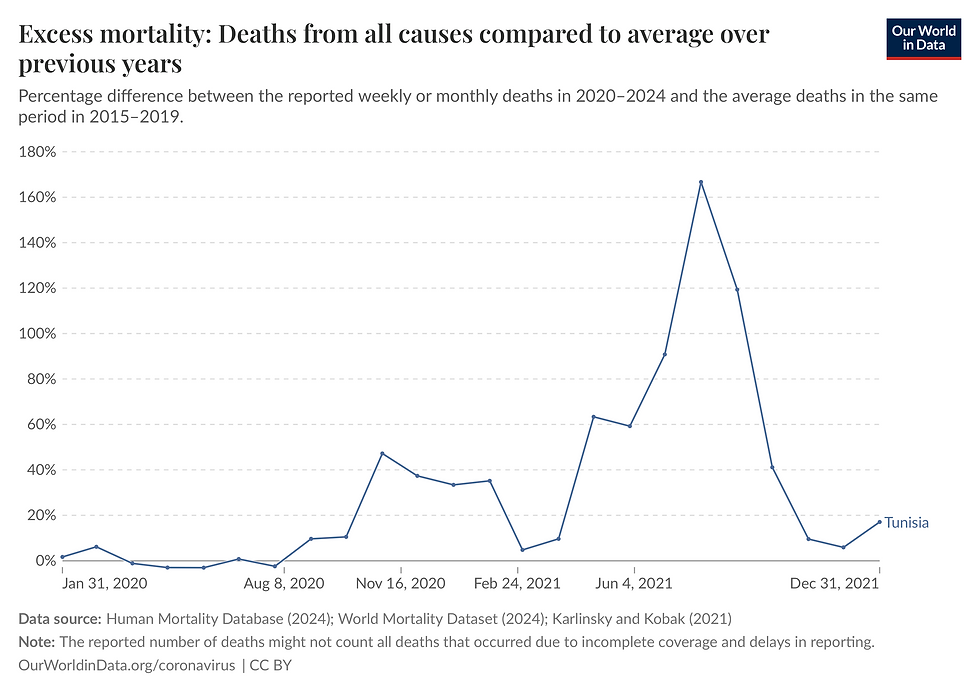
Tunisia recorded an extraordinary number of daily Covid-19 deaths in the summer of 2021, primarily in July. On 24 July 2021, DW reported that less than 8% of the population was fully vaccinated and the vaccination rollout was moving slowly.
Tunisia recorded the second-highest number of deaths globally, in proportion to its population, during the final week of July. Only the British Virgin Islands reported a higher rate. In July alone, Tunisia recorded about 5000 Covid-19 deaths according to the same source, an incredibly high number for a country of 12 million people and for a summer season. The health crisis was caused by the Delta variant.
The following articles describe how serious the situation was.
● 5 graphs to better understand the magnitude of Covid-19-related deaths in Tunisia — August 2, 2021 (Inkyfada)
● Tunisia COVID-19 situation ‘catastrophic’ — July 8, 2021 (Al Jazeera)
● Europe sends aid to help Tunisia counter COVID surge — July 16, 2021 (Asharq Al-Awsat)
● Tunisia reports daily record 205 coronavirus deaths — July 16, 2021 (Reuters)
● Tunisia’s COVID-19 surge spells disaster — July 24, 2021 (DW)
● Tunisian hospitals overwhelmed as COVID-19 surges across Africa — July 28, 2021 (World Socialist Web Site)
Excess mortality in Tunisia from January 2020 to December 2021. Source: Our World in Data.
Japan, June 2022
Japan experienced its most severe heatwave on record, particularly rare for the month June. It was noteworthy for both its intensity and persistence.
● Heat waves topple monthly all-time records from Japan to Italy — June 30, 2022 (Axios)
● Extreme Temperatures Around The World — June 30, 2022
The X post refers to a monster heatwave in Japan with 150 more monthly records of highest temperatures broken on June 30, 2022.
● Japan swelters in its worst heatwave ever recorded — June 29, 2022 (BBC)
Japan, August 2022
Japan topped the global COVID chart in late July.
● Japan tops global COVID chart, dimming reopening hopes — July 27, 2022 (Nikkei Asia)
● Japan's COVID-19 cases spike, medical system overwhelmed — August 20, 2022 (Xinhua)
A website, now taken down, recorded the severity of the situation in August in Tokyo. Hospital bed occupancy rate in Tokyo peaked at nearly 60% for a couple of weeks in August 2022.
Other sources for August 2022:
● Crematoriums in east Japan city overcrowded as COVID death toll soars — September 8, 2022 (The Mainichi)
● Japan's COVID-19 cases more than doubled in 2 months — September 10, 2022 (Xinhua)
● Excess mortality in Japan, August 2022 — August 2022 (Japan Ministry of Health)
The excess mortality in Japan for August 2022 was 29% higher than the average of the years 2015-2019.
Excess mortality in Japan from April 2021 to May 2023. Source: Our World in Data.

SOUTH AMERICA - Introduction
In 2021 according to the report “State of Climate in 2021”, for the second year in a row, large parts of subtropical South America experienced severe drought conditions. Central and southern regions of Brazil, along with Paraguay, Uruguay, and northern Argentina, received substantially less rainfall than usual. The severe drought led to significant agricultural losses in the region.
State of Climate in 2021: Extreme Events and Major Impacts — October 31, 2021 (United Nations)
Drought in Chile and Argentina started in late October 2020 and continued for 19 months, until early June 2022, according to this report.
Cindy Fernandez, a meteorologist with Argentina’s National Meteorological Service, stated that practically all of Argentina, along with neighboring countries like Uruguay, southern Brazil, and Paraguay, were facing some of the highest temperatures ever recorded.
The source is an article of Reuters, published on January 14, 2022.
All excess mortality charts below for South America cover the period from October 2020 to August 2022. The source is Our World in Data.
Paraguay, December 2021-January 2022
Paraguay’s agriculture minister, Moisés Bertoni, stated that things were going well up until late November 2021, but December brought very dry conditions, and January 2022 saw extreme heat, which had an impact on soya, Paraguay’s leading export crop.
Paraguay, January-February 2022

Uruguay, December 2021-January 2022
In Uruguay, the most recent heatwave followed closely after a previous one that took place between December 2021 and early January 2022. The heatwave triggered wildfires that burned approximately 37,000 hectares of forest in the country’s western region, marking the worst forest devastation ever recorded in Uruguay. The source is the report “Latin America & The Caribbean Weekly Situation Update (17-23 January 2022) As of 24 January 2022”
Uruguay, January-February 2022

Argentina, November 2021-January 2022
Drought in Argentina began in November 2021 and continued into February 2022. The country experienced its warmest November-January on record and a historic heatwave, noteworthy for its long duration and high intensity, from 9 to 19 January 2022. The capital city of Buenos Aires experienced an episode of exceptional heat, extremely rare in its intensity. Such an extreme heatwave has been observed only once in the 117 years of meteorological records for Buenos Aires. Since 2019, large regions of Argentina and nearby nations have been struggling with severe drought. In fact, during the final four months of 2022, they received less than half of the average precipitation. It was the lowest rainfall in 35 years.
Sources:
●Wildfires Ravage Corrientes, Argentina — February 16, 2022 (Earth Observatory, NASA)
●Heat and drought bite in large parts of South America — February 21, 2023 (World Meteorological Organization)
●Study: Bo Zhang and Zhiang Xie. Mechanism of the Record-Breaking Heatwave Event Dynamics in South America in January 2022 https://www.mdpi.com/2073-4433/14/9/1326
Argentina, January-February 2022
I present Argentina’s excess mortality graph along with the one for Uruguay. The second chart combines data from four South American countries, Brazil, Argentina, Paraguay and Uruguay. Both charts are from Our World in Data.


New Zealand, January 2022
The vast majority of New Zealand experienced significantly reduced rainfall in January 2022, either below normal (50-79% of normal) or well below normal (<50% of normal). with many areas receiving less than 80% of their usual totals, and some getting less than half. This widespread dryness affected almost the entire North Island, as well as the upper, western, and lower parts of the South Island. The article continues, that the unusually dry conditions were largely due to persistent high-pressure dominating the region throughout the month. A total of 16 locations recorded their driest January ever. In Auckland, a 37-day dry spell from 17 December 2021 to 22 January 2022 became the city's second-longest on record since 1943.
● New Zealand: Monthly climate summary - January 2022 - A warm and very dry month for most locations.
New Zealand since February 2022
I include an additional chart. Both charts are from Our World in Data.
Daily new confirmed COVID-19 cases and deaths, New Zealand, 7-day rolling average.

Excess mortality in New Zealand. Deaths from all causes compared to average over previous years.

Portugal, May-July 2022
Portugal has been suffering from a drought since October 2021.
● Drought improves in Portugal, but in 77% of country it is still severe or extreme — March 17, 2022 (Infobae)
● Temperature records tumble in early, intense heatwave — June 20, 2022 (World Meteorological Organization)
● Nearly all of Portugal in severe drought after hottest May in 92 years — June 10, 2022 (Euronews)
● Europe suffers under major heatwave, faces drought and wildfires — July 12, 2022 (Euronews)
● Portugal sets July heat record as severe drought continues — August 5, 2022 (Euronews)
The country had unusually hot and dry weather in May, June and July, according to the following articles. I will summarize the main points of the three articles below.
The first article from June 20, 2022, reports that according to the Portuguese Institute for Sea and Atmosphere (IPMA), May 2022 was the hottest since 1931, with drought impacting 97% of Portugal.
Spain suffered a drought as well. Meanwhile, France experienced the hottest and driest May on record. Météo-France noted that the heatwave was the earliest on record and ranked among the most intense ever observed.
According to another article from the Associated Press on July 7, 2022, the drought in Portugal continued. By the end of June, 96% of the country was experiencing either "severe" or "extreme" drought, the two highest categories. The weather service reported that rainfall from October 2021 through June 2022 was just slightly above half the average for that period, making it the second-lowest since 1931, the year reliable record-keeping began. June was also unusually dry in neighboring Spain. Rainfall was roughly 50% of the 30-year average, and the country’s reservoirs were, on average, filled to just 45% of their capacity, about 20 percentage points lower than the 10-year average.
In Italy, an extended heatwave swept through the country, and was experiencing its worst drought in seven decades.
A more recent article from the Associated Press, dated August 5, 2022, reports that Portugal experienced its hottest July on record according to the country’s weather service. Portugal’s drought intensified with the summer heat, and by late July, 45% of the mainland was facing “extreme drought” while the the rest of it was facing “severe drought”, the two highest classifications. The Portuguese weather service (IPMA), said July was the hottest since 1931, the year national records began. The average temperature in July was 25.14°C, nearly 3°C above the typical July average. Rainfall was also far below normal, with just 3 millimeters recorded, about 22% the normal amount for July.
Other sources:
● This was the hottest May of the last 92 years in Portugal — June 9, 2022 (Sul Informação)
● Portugal faces worst drought on record — July 31, 2022 (China Daily)
● Extreme Temperatures Around The World — August 19, 2022 (X message)
The author of the X post reported that July 2022 in Portugal registered an average temperature of 25.14°C which is +2.97°C above the 1971-2000 baseline and about 2.3°C above the 1991–2020 period. This made it the hottest July ever recorded in the country. Rainfall was extremely scarce as well, totaling only about 3 mm, which is 22% of normal.
● Portugal sets July heat record as severe drought continues — August 5, 2022 (Euronews and AP)
Covid cases began rising in Portugal in November 2021 and peaked in January 2022. The persistence of Covid cases and deaths for 8 consecutive months is remarkable.
Portugal, June to August 2022
Based on incomplete data, Portugal and Spain appear to have suffered the worst rise in excess deaths in the summer of 2022, among Western European countries that also had a problem. Significant excess mortality was observed from spring 2022 onward in the UK, Netherlands, Germany, Austria, Switzerland, the latter four showing very similar trends.
According to a Portugal News article from June 20, 2022, Portugal continued to register the highest number of new SARS-CoV-2 cases per million people within the European Union in the previous week, and ranked second globally in this indicator.
Excess mortality in Spain and Portugal, from January 2022 to January 2023. Source: Our World in Data.

Excess mortality statistics from Europe - Provided by Eurostat
May 2022
June 2022
July 2022
An article of Eurostat for the month of August was not available.
Taiwan, April-May 2022
Taiwan recorded abnormal dull skies in May 2022. The country received only 86 hours of sunlight, significantly less than the 10-year average of 152.9 hours. A month earlier, in April, the average rainfall was 92.5mm, which is 35.6mm below normal.
Sources:
● Taiwan records dullest May skies this year — June 28, 2022 (Focus Taiwan)
● Abnormal weather dampens millet harvest in east Taiwan — June 11, 2022 (Taiwan News)
● Extreme Temperatures Around The World — April 2022 (X message)
Taiwan, since May 2022
Taiwan, with a population of 23 million has recorded more than a hundred Covid-19 deaths per day from May 26, until July.
● Taiwan reports second-most COVID-19 weekly cases and deaths only behind the U.S. — June 12, 2022 (UPI)
The article refers to the week from 5 to 12 June 2012. In the months prior to May, Taiwan recorded just a few cases and deaths.
● Taiwan’s COVID-19 cases reach plateau, government says — May 27, 2022 (Reuters)
Excess mortality in Taiwan from January 2020 to December 2024. Source: Our World in Data.

Uzbekistan, June 2023
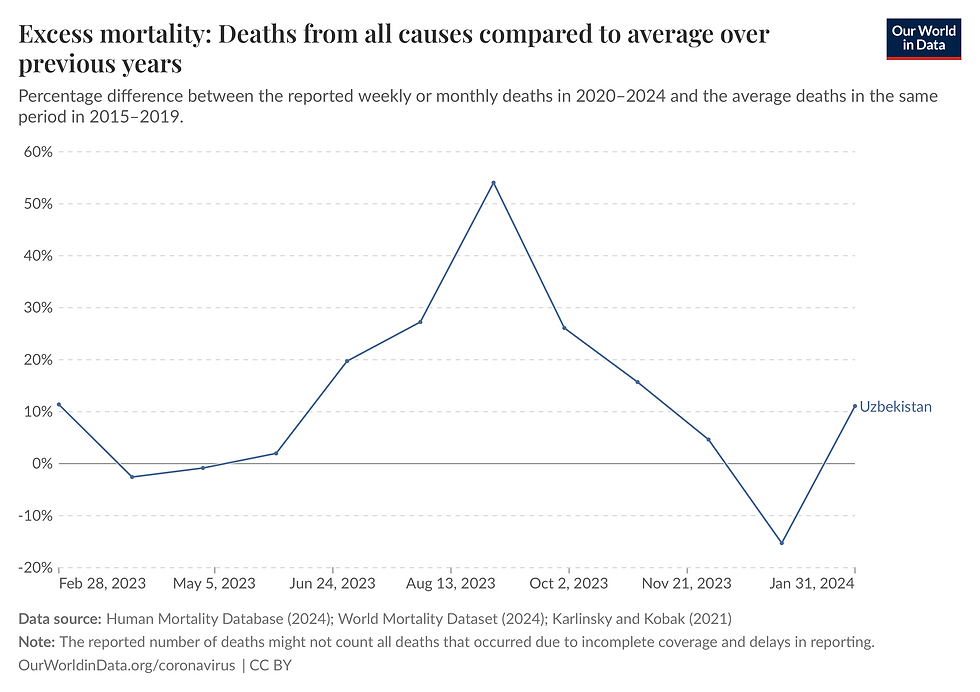
In most regions of Uzbekistan, June 2023 ranked as the hottest June on record. Throughout the month, air temperature was 3–5°C above the annual values. Along with the abnormal heat, the period was marked by extreme dryness across much of the country. Meteorologists reported that the amount of precipitation reached only about 0–30% of the typical June levels. — July 5, 2023 (Kun.uz)
● June 2023 broke records for hottest days in Tashkent — July 5, 2023 (Kun.uz)
Uzbekistan, July to September 2023
Excess mortality in Uzbekistan from February 2023 to January 2024. Source: Our World in Data.
Cyprus, June to August 2024
June 2024 has been recorded as the hottest month in Cyprus' meteorological history…
Along the coast, the average daily maximum temperature was 3.6 to 4.1°C above the June norms observed by each station. Inland areas registered an average daily maximum temperature exceeding the norm by 5.7°C, and at the Prodromos Forestry College mountain station, it was 5.6°C above average.
The average daily minimum temperature on the island's coast was 3.2 to 4.9°C above normal, while inland areas exceeded the norm by 3.9°C, and in the mountains by 4.7°C.
In addition to scorching temperatures, Cyprus experienced significantly lower rainfall in June.
The information has been provided by the following source.
● June 2024 became the hottest month in Cyprus' climatological history — July 17, 2024 (Cyprus FAQ)
Philenews reported that, according to the Department of Meteorology, in July the average temperatures across the island were between 2.5 and 3.6°C above normal, affecting all weather stations, coastal and inland. The announcement was made on August 19, 2024.
● Cyprus recorded hottest July on record — August 19, 2024 (Philenews)
Cyprus, June 2024 to January 2025
Cyprus recorded, on average, the highest excess mortality in Europe from June 2024 to January 2025. The source is articles posted by Eurostat. The articles have changed monthly or every few months but the website address remains the same, meaning the reader can only see the latest update.
I relied on the figures from Eurostat tables for December 2024 and January 2025.
Countries with the highest excess mortality in Europe.
June 2024: Cyprus (28.9%), Ireland (15.3%), Netherlands (15.0%).
July 2024: Malta (26.7%), Greece (25.2%), Cyprus (24.8%).
August 2024: Malta (37.6%), Cyprus (24.1%) and Ireland (19.3%).
September 2024: Malta (39%), Austria (16.5%), Cyprus (16.2%), Luxembourg (15.2%), Finland (13.7%).
October 2024: Cyprus (17.2%), Austria (17.1%), Malta (16.8%), Germany (14.3%) and the Netherlands (12.8%).
November 2024: Finland (18.4%), Cyprus (18.0%), and the Netherlands (13.9%).
December 2024: Cyprus (24.8%), Malta (19.1%), Luxembourg (17.3%), Iceland (11.8%), Ireland (11.7%).
January 2025: Cyprus (22.6%), Luxembourg (21.5%), Iceland (19.7%), Netherlands (17.3%), France (17%), Belgium (16.6%).
Source: Eurostat, © European Union, 1995–2025. Reuse is authorised under the Creative Commons Attribution 4.0 International (CC BY 4.0) license.
Greece, June-July 2024
June and July 2024 were recorded as the hottest months ever observed in Greece since weather records began in 1960.
The summer of 2024 set a new temperature record for the country, with temperatures 2.9°C higher than the average temperature for the period 1991–2020 and about 1°C above the previous warmest summer of 2012.
From 1960 to 2024, the long-term trend in Greece’s average summer temperatures indicates an overall increase of 2.3°C.
I quote an article from monomaxos website:
June 2024 is +3.8°C above the 1991-2020 average and +2°C above the previous warmest June record in 2012.
July 2024 ranks as the warmest on record, with a temperature of +2.9°C above the 1991-2020 average and +0.3°C above the previous warmest July in 2012. It is noteworthy that the last four years have seen three of the four warmest July months in Greece in at least the last 80 years.
This year's August, like June and July, had many days with high temperatures and was the warmest August since 2010 for the regions of north-west Greece, the Ionian and the Peloponnese, with average monthly values of up to +1.8°C above normal levels for the season.
Sources:
Some titles are freely translated from Greek to English.
● Hottest June since 1960 in Greece — July 6, 2024 (Athens Voice)
● The hottest June, temperatures 4–8°C above normal — July 6, 2024 (Flash)
● July 2024 hottest in Greek historical records — August 5, 2024 (Kathimerini)
● Summer 2024 hottest in Greece since records began — September 8, 2024 (Tornos News)
● Greece experiences hottest July on record — August 6, 2024 (Greek Reporter)
● August 2024 hottest in northern & western Greece, and Peloponnese — September 2024 (Monomaxos)
● August 2024 hottest in northern & western Greece, Peloponnese — September 2, 2024 (In.gr)
Greece, July-August 2024
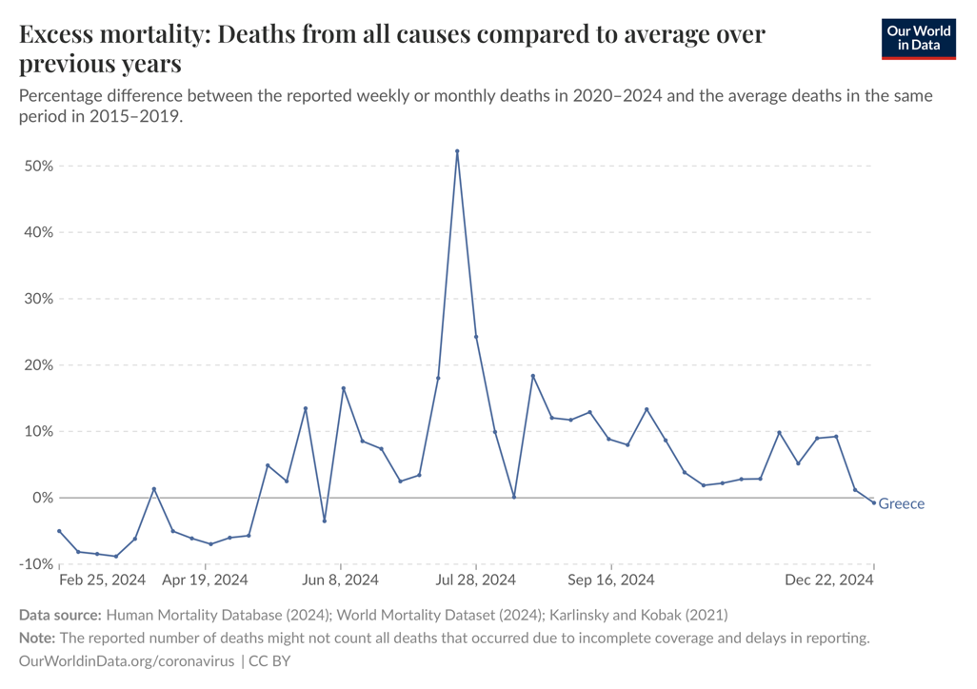
The excess mortality in August 2024 in Greece was 11.7%, a significant decrease from the previous month of July. In July it was 25.2%. However, regarding the respiratory disease diagnosed as COVID-19 the situation in August in the hospitals was just as serious, if not slightly worse than in July. In July and August 2024, Greece experienced an unusual COVID-19 wave for the season, with many hospital admissions. On July 20, Garyfallia Poulakou, an infectious disease specialist at the Sotiria Hospital in Athens, reported to a radio station that according to her estimates, nearly every household in Greece had at least one person sick with COVID-19.
This article presents the weekly statistics for Greece in respect to COVID-19, for the period up to the end of August 2024.
● Another source: Greece’s COVID surge in holiday season fuels global spread — July 28, 2024 (World Socialist Web Site)
Excess mortality in Greece from February to December 2024. Source: Our World in Data.
Eurostat sources


